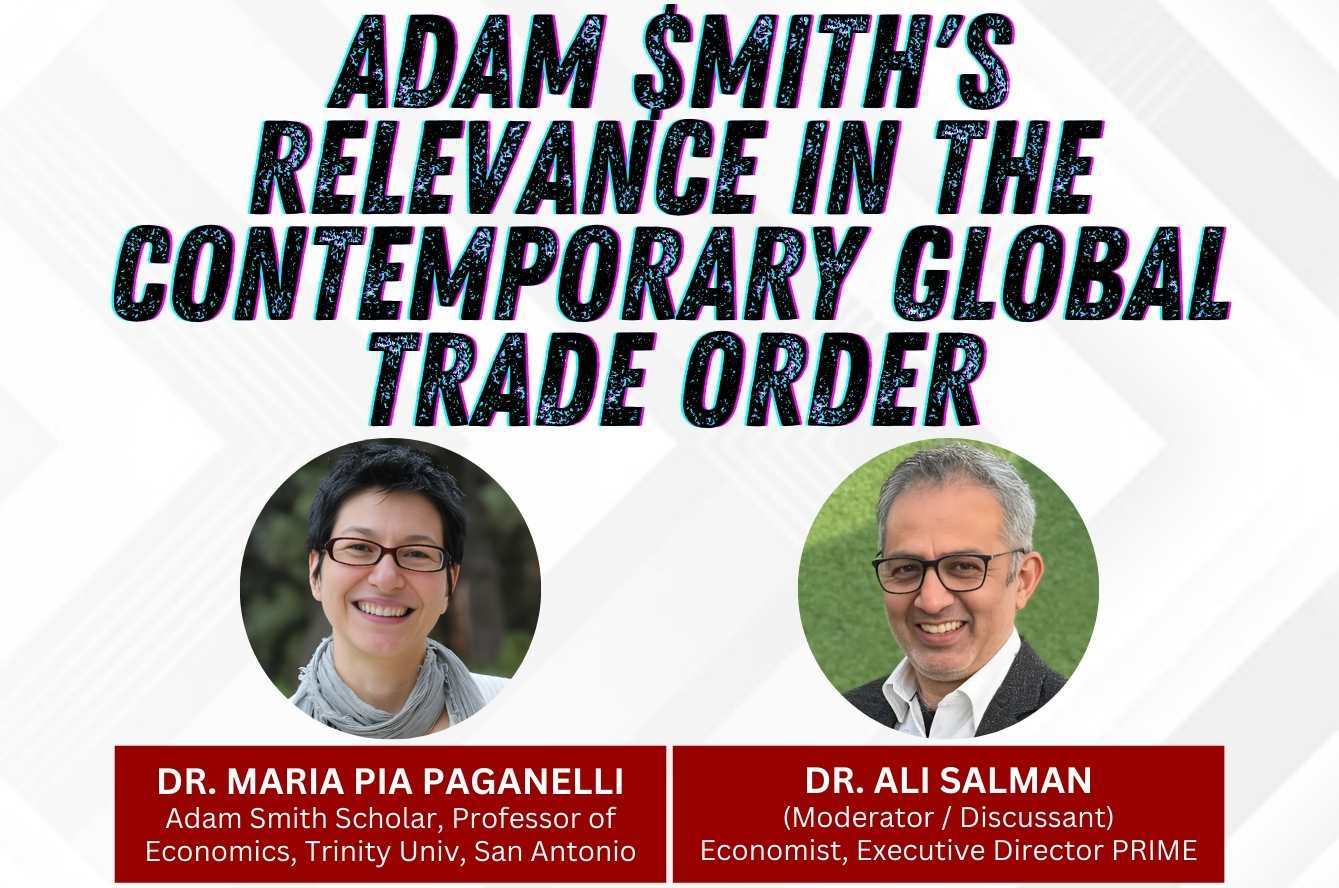
Adam Smith’s Relevance in the Contemporary Global Trade Order
In an era marked by trade wars, protectionism, and shifting economic power, the ideas of Adam Smith are often invoked yet rarely examined in depth.
This seminar revisits Smith’s core insights on markets, trade, and political economy to assess their relevance in today’s global trade order. From free trade and specialization to state intervention and moral limits of markets, the discussion explores whether Smith’s ideas still offer guidance, or caution, for understanding contemporary global commerce.
About the Guest Speaker:
Dr. Maria Pia Paganelli is Professor of Economics at Trinity University, San Antonio, where she teaches principles of economics, law and economics, Smithian economics, and interdisciplinary courses including a study-abroad program on the history of Iceland. She holds a BA and MA in Political Science from Università Cattolica del Sacro Cuore, and an MA and PhD in Economics from George Mason University.
A leading scholar of Adam Smith and the history of economic thought, Dr. Paganelli has published extensively in leading journals such as History of Political Economy, Cambridge Journal of Economics, Journal of the History of Economic Thought, and History of Economic Ideas. She is the author of The Routledge Guidebook to Adam Smith’s Wealth of Nations (2020) and co-editor of Adam Smith and Rousseau: Ethics, Politics and Economics (2018) and The Oxford Handbook of Adam Smith (2013).
Her scholarship has been internationally recognized, including the European Society for the History of Economic Thought’s Best Article of the Year Award for her influential paper on Adam Smith’s moral and economic philosophy. Dr. Paganelli has served as Book Review Editor of the Journal of the History of Economic Thought, Vice-President of the History of Economics Society, and is currently President of both the International Adam Smith Society and the History of Economics Society.
About the Moderator:
Dr. Ali Salman is the founder and Executive Director of Policy Research Institute of Market Economy (PRIME), an independent economic policy think tank in Islamabad. Dr. Ali has remained actively engaged with the government as an economist and public policy expert over years. He is a contributor and co-author in two background papers for the three years growth strategy for the Planning Commission. He has advised the Competition Commission analyzing economic implications of legal decisions. He has also served on the Board of Punjab Saaf Pani Company as an independent director, a government owned company for provisioning of clean drinking water. Ali played an instrumental role in writing Pakistan’s first youth policy while working with the Government of the Punjab. His evaluation of Government’s Education Vouchers scheme helped the authorities and donors to use his report as evidence to scale up the programme significantly, which now caters to more than one million students.
Dr. Ali received doctorate in Policy Research and Practice, from the University of Bath, UK, where he wrote thesis on “Policy discovery through a complexity lens: case studies of economic reforms and policy practice in Malaysia and Pakistan. Ali holds master’s degrees in Economics, Public Policy, and Business Administration. He is recipient of Fulbright Scholarship, Royal Netherlands Fellowship and Charles Wallace Fellowship. He has conducted training workshops in Pakistan and other countries. He writes op-eds for Express Tribune, a partner publication of the New York Times. Ali has taught courses on Economics and Entrepreneurship as an adjunct faculty in the Government College University Lahore.
This session is free and open to all. Just visit the venue to attend it.
The Black Hole
Plot 5H, Street 100, G-11/3, Islamabad.
Click here for Google Maps Location