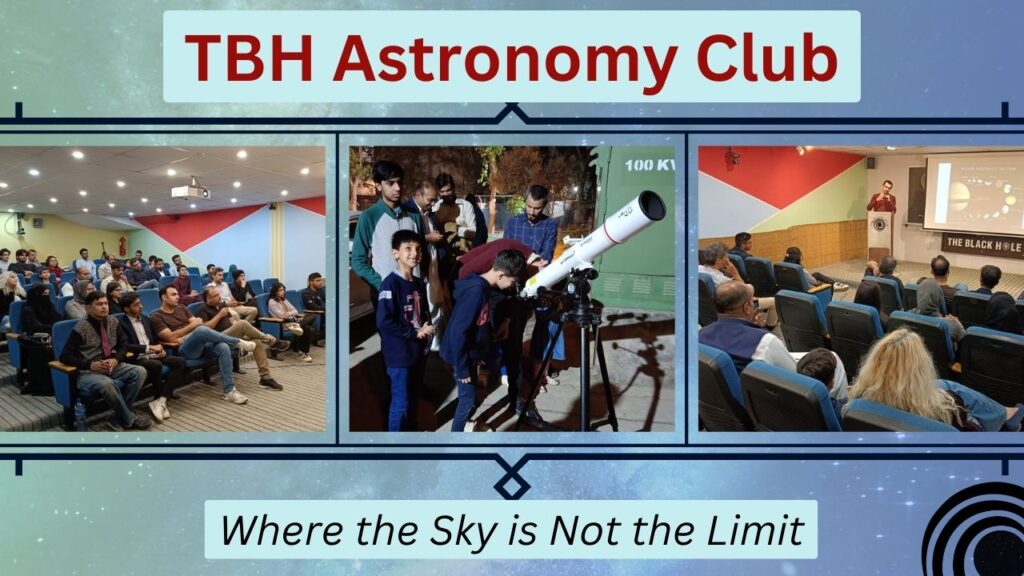
In September 2023, our astronomy journey took a giant leap forward when TBH received a state-of-the-art telescope through a generous donation from CERN. Our first public stargazing session in December 2023 marked the beginning of what has become a cherished community tradition. Since then, we’ve been hosting regular monthly observations that consistently draw hundreds of enthusiasts from the twin cities of Islamabad and Rawalpindi.
We proudly operate a Bresser Messier AR-90/900 refractor telescope, featuring:
- 90mm aperture
- 900mm focal length
- f/10 focal ratio
- 26x magnification capability
- Superior optical clarity for both planetary and deep-sky observation
Through our telescope, participants have marveled at various celestial wonders, including:
- The Moon and its craters
- Jupiter, its cloud bands and Galilean moons
- Saturn and its magnificent rings
- The Orion Nebula
- The sparkling star cluster, called the Pleiades or the Seven Sisters
Our commitment to astronomy education extends beyond stargazing sessions. We regularly:
- Organize lectures by distinguished astronomers, space scientists and astrophotographers
- Host interactive workshops on basic astronomy
- Conduct special sessions for students and amateur astronomers
We’re passionate about bringing the wonders of the night sky to young minds. Our mobile astronomy program has successfully visited several educational institutions, including:
- Khaldunia School
- Froebel’s International School
- Westminster Academy
- Government Boys School G-13
If you’d like to organize a stargazing session at your institution, please note:
- We currently serve schools within Islamabad city limits
- Transportation for our team and equipment must be arranged by the host school
- Sessions can be scheduled through the form below
Please click here to fill a registration form so that our team can contact you.
2nd Oct 2025: Our Spectacular Solar System
We journeyed through the wonders of our solar system with Dr. Waqas Masood, Head of the Physics Department at COMSATS University Islamabad, recipient of the Pride of Performance (2012) and the Salam Prize in Physics (2009). Designed especially for students, the session explored the blazing Sun, giant storms on Jupiter, Saturn’s iconic rings, and the mysteries of Mars – sparking curiosity and bringing the beauty of astronomy vividly to life.
3rd Oct 2025: Cosmic Coincidences – Why Planet Earth is So Special
As part of Space Week 2025, Khawar Ali Sher – a core team member of Pak Astronomers Islamabad – took young audiences on a fascinating journey to discover what makes our home planet truly extraordinary. The session explored Earth’s perfect position in the solar system, its protective atmosphere, flowing water and the delicate balance that allows life to flourish.
4th Oct 2025: The Beginners’ Guide to Astrophotography
Dr. Farrukh Shahzad – Vice President of PakAstronomers Islamabad – introduced participants to the captivating world of astrophotography. The session blended astronomy with artistic expression, guiding beginners through the essentials of capturing the night sky using DSLRs, smartphones, or telescopes. From star trails and lunar craters to the sweeping Milky Way, Dr. Shahzad shared practical tips and insights that inspired participants to turn their curiosity and patience into stunning celestial images.
6th Oct 2025: A Pakistani Perspective into Astronomy
Zainab Abbasi – Event Manager at PakAstronomers and an enthusiastic science communicator – shared her inspiring journey of bringing the wonders of the universe closer to Pakistan’s youth. Through her talk, she highlighted how astronomy can thrive within local contexts, encouraging young minds to look up at the night sky with curiosity, passion and a sense of belonging to a global community of stargazers.
7th Oct 2025: From Sputnik to Starlink – A Journey Through Satellite Technology & Applications
Dr. Najam Abbas Naqvi – Chairman and Central Project Director of the National Center of GIS and Space Applications (NCGSA) – took the audience on a illuminating journey through the history and evolution of satellite technology. From the launch of Sputnik in 1957 to the modern Starlink network, he explored how satellites have revolutionized communication, navigation, defense and weather forecasting. The session highlighted how these orbiting machines continue to shape human life and innovation, connecting Earth to the vast frontier of space.
7th Oct 2025: Life Beyond Earth: the Reality and Challenges
Zain Mobeen, a PhD student in astrophysics at the Nicolaus Copernicus Astronomical Center in Poland, guided participants through the fascinating search for life beyond our planet. The session explored current research on Mars, distant exoplanets and other cosmic frontiers, while addressing the scientific, technological, and ethical challenges of discovering extraterrestrial life. Participants reflected on what such discoveries could mean for humanity and our understanding of the universe.
Muhammad Sanan Qureshi
sanan@theblackhole.pk
Senior Science Instructor and Astronomy Club Lead
The Black Hole