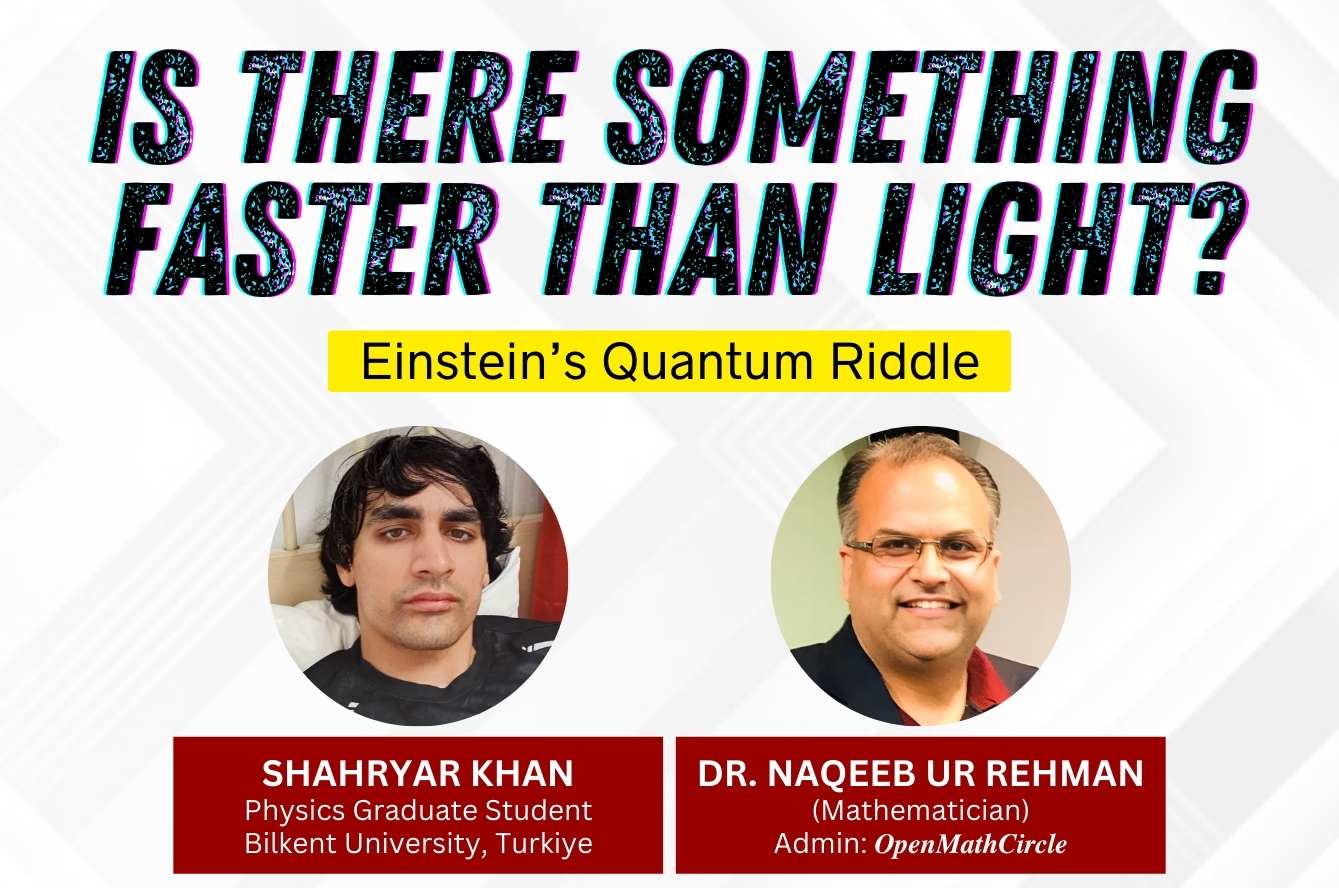
Is There Something Faster than Light? Einstein’s Quantum Riddle
At the start of the 20th century Albert Einstein helped usher in quantum mechanics – a revolutionary description of the behaviour of tiny particles. But he soon became uncomfortable with the counterintuitive ideas at the heart of the theory. He hunted for flaws in the equations and eventually discovered that they predicted a seemingly impossible situation that you could have two particles, which had interacted in the past, and even if you separated them by millions of miles they would somehow act instantly in unison.
This bizarre prediction of magically connected particles became known as quantum entanglement. Often described as ‘instant communication’ between distant particles, it raises a provocative question: does anything travel faster than light? Einstein felt it couldn’t possibly be real and called it spooky action at a distance (spukhafte fernwirkung) that seemed to break the rules of space and time. In 1935, with two of his colleagues Podolsky and Rosen, he published a paper titled “Can Quantum-Mechanical Description of Physical Reality be Considered Complete?”, and argued for the existence of hidden elements of reality that were not part of quantum theory, and speculated that it should be possible to construct a theory containing these hidden variables.
Einstein’s Quantum Riddle tells the remarkable story of perhaps the strangest phenomenon in science. It’s a story of mind-bending concepts and brilliant experiments, which lead us to a profound new understanding of reality. Today quantum entanglement is poised to revolutionize technology from computers to cryptography. From an experiment studying quasars at opposite ends of the universe to probing the interactions of elementary particles, researchers are gathering insights that could shatter the laws of space and time and provide a radical new understanding of the universe. This documentary presents cutting-edge work and considers various implications of the coming quantum revolution that begins with making sense of the quantum world.
The screening will be followed by discussion and Q&A session with Dr. Naqeeb ur Rehman and Shahryar Khan. Rather than focusing on heavy mathematics, the discussion will emphasize conceptual clarity, helping participants understand why entanglement challenges our intuitions about space, separation and causality, while still remaining consistent with the laws of physics.
About the Speakers:
- Naqeeb ur Rehman is a mathematician with a PhD earned through the prestigious DAAD research program in Germany. His teaching expertise and interests extend from basic to the university levels, in the areas of algebra, topology, knot theory, cellular automata, and mathematical philosophy. As an active math educator and STEAM safeer, he regularly conducts math circles, seminars, and talks at various educational institutions. Besides, he also runs the 𝑶𝒑𝒆𝒏𝑴𝒂𝒕𝒉𝑪𝒊𝒓𝒄𝒍𝒆 Facebook page and YouTube channel.
- Shahryar Khan is a physics graduate student at Bilkent University, Turkiye. His research interests range from cosmology to condensed matter physics to chaos theory. He is also deeply interested in pure mathematics, philosophy and artificial intelligence.
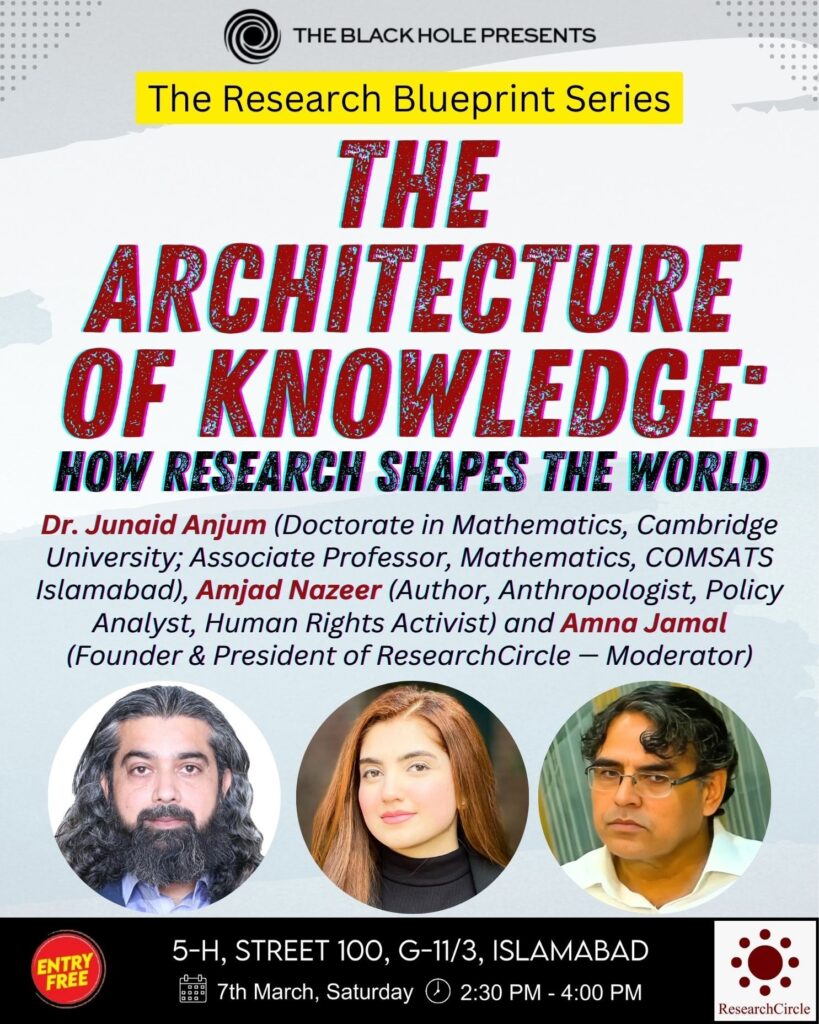
This session is free and open to all. Just visit the venue to attend it.
The Black Hole
Plot 5H, Street 100, G-11/3, Islamabad.
Click here for Google Maps Location