Politics of/in Translation: Meaning Across Languages and Borders
Translation is often seen as a simple linguistic act, but in South Asia – especially during the colonial era – it became a deeply political tool that shaped thought, identity and power. British administrators and scholars strategically used translation to construct a body of “knowledge” aligned with imperial interests. By selectively translating religious, legal and literary texts, and reframing them through Eurocentric lenses, they created mental and cultural templates that reinforced colonial authority.
These translations produced fixed images of local communities, portraying them as backward, irrational or in need of civilizing guidance, thereby legitimizing imperial rule. In this process, translation became a mechanism of narrative control: amplifying certain worldviews while silencing indigenous intellectual traditions. It influenced how both colonizer and colonized came to understand history, culture and themselves.
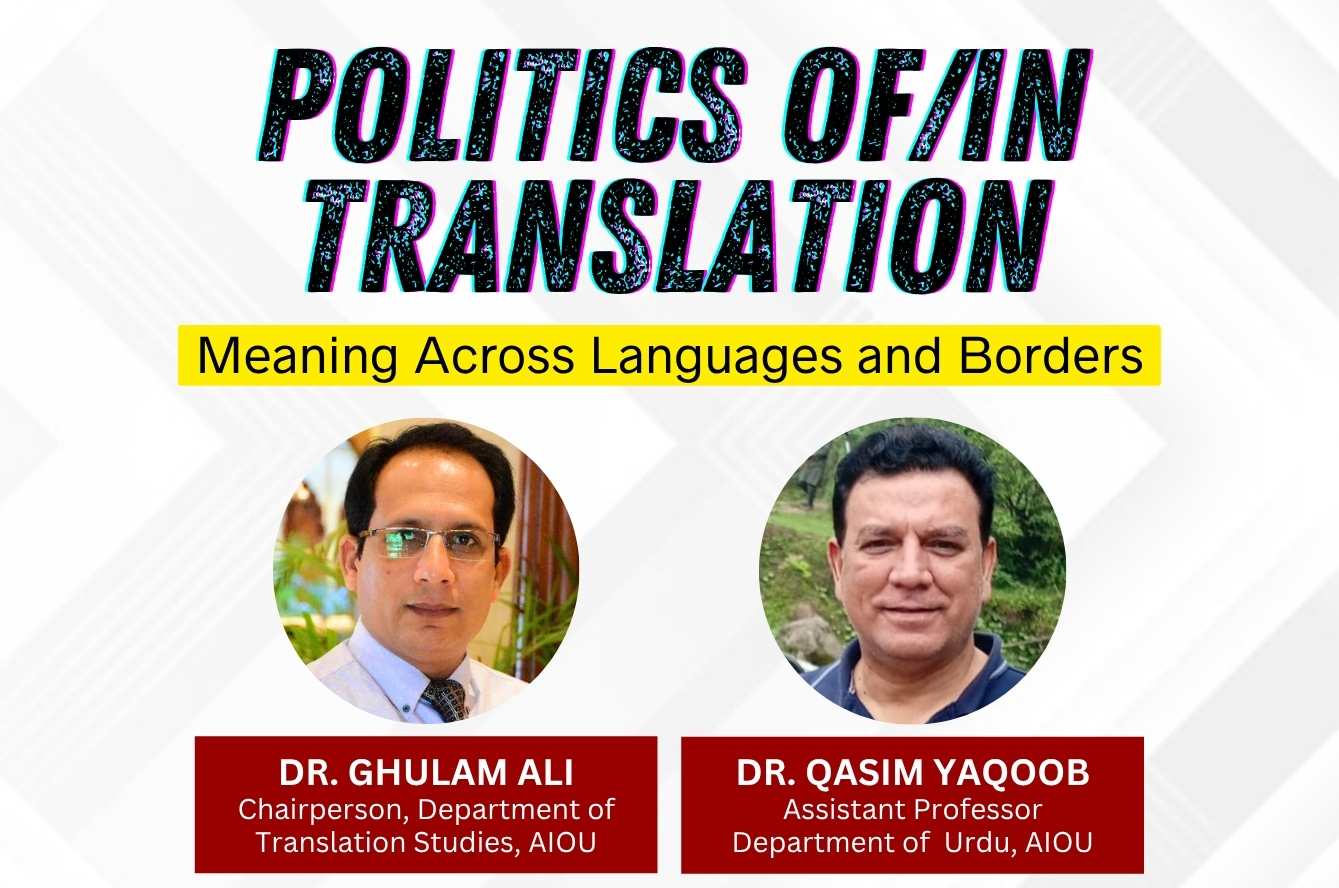
In this session, we engage in a dialogue with Dr. Ghulam Ali, Head of the Department of Translation at Allama Iqbal Open University (AIOU) and Dr. Qasim Yaqoob, Assistant Professor of the Department of Urdu, AIOU to explore not only the colonial history of translation but also the broader politics embedded in translation practices. It examines how translation can be used to shape public discourse, construct new ideologies and reproduce biases that continue to affect societies today.
This session is free and open to all. Just visit the venue to attend it.
The Black Hole
Plot 5H, Street 100, G-11/3, Islamabad.
Click here for Google Maps Location