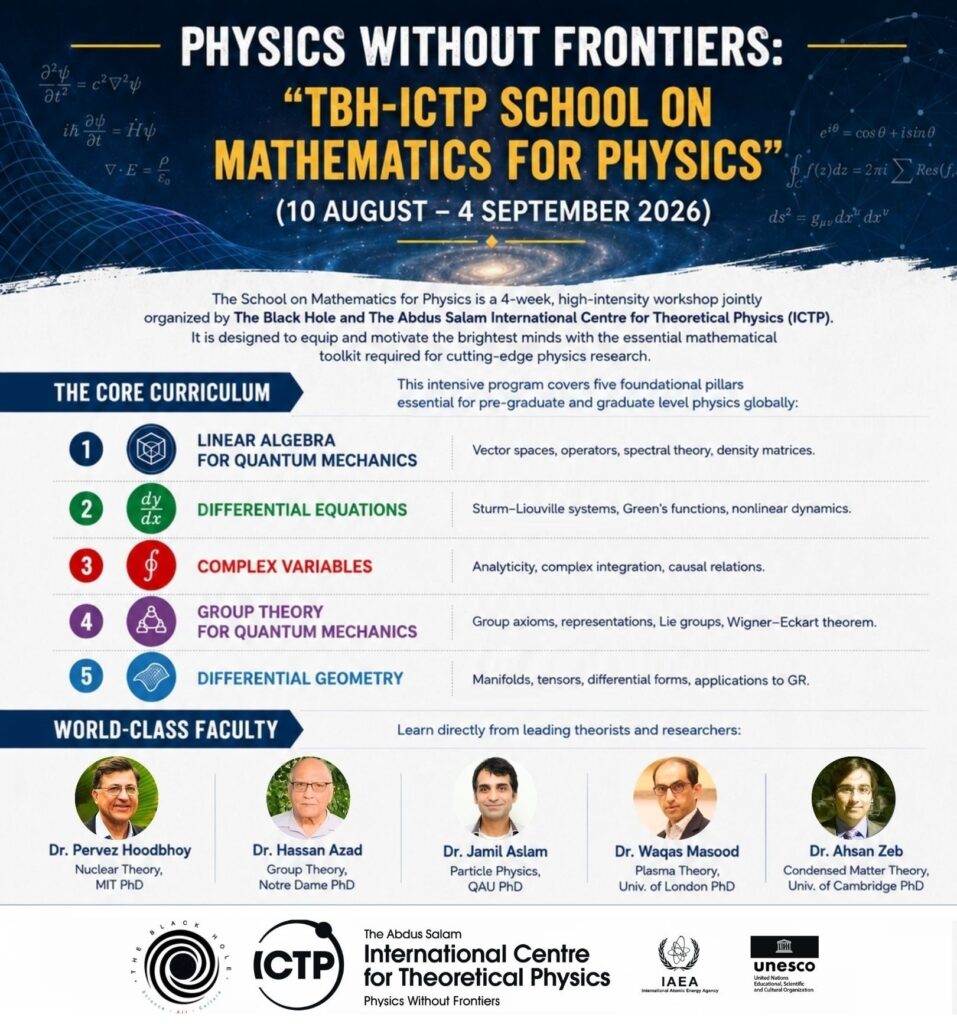
Theoretical physics has historically driven humanity’s greatest discoveries, yet it remains critically underdeveloped in Pakistan today. The School on Mathematics for Physics is a 4-week, high-intensity workshop jointly organized by The Black Hole and The Abdus Salam International Centre for Theoretical Physics (ICTP). It is designed to equip and motivate the brightest minds with the essential mathematical toolkit required for cutting-edge physics research.
The Core Curriculum
This intensive program covers five foundational pillars essential for pre-graduate and graduate level physics globally:
- Linear Algebra for Quantum Mechanics: Vector spaces, operators, spectral theory, density matrices.
- Differential Equations: Sturm-Liouville systems, Green’s functions, nonlinear dynamics.
- Complex Variables: Analyticity, complex integration, causal relations.
- Group Theory for Quantum Mechanics: Group axioms, representations, Lie groups, Wigner-Eckart theorem.
- Differential Geometry: Manifolds, tensors, differential forms, applications to GR.
World-Class Faculty
Learn directly from leading theorists and researchers:
- Dr. Pervez Hoodbhoy (Nuclear Theory, MIT PhD)
- Dr. Hassan Azad (Group Theory, Notre Dame PhD)
- Dr. Jamil Aslam (Particle Physics, QAU PhD)
- Dr. Waqas Masood (Plasma Theory, Univ. of London PhD)
- Dr. Ahsan Zeb (Condensed Matter Theory, Univ. of Cambridge PhD)
Modalities & Structure
- Rigorous Pace: 2 lectures daily of 90 minutes each for four weeks (8 lectures per instructor)
- Interactive: Dedicated time built-in daily for deep-dive discussions.
- Exclusive Cohort: 20 students selected globally based on a strict competitive review.
- Recognition: A formal certificate will be awarded upon successful completion of the school.
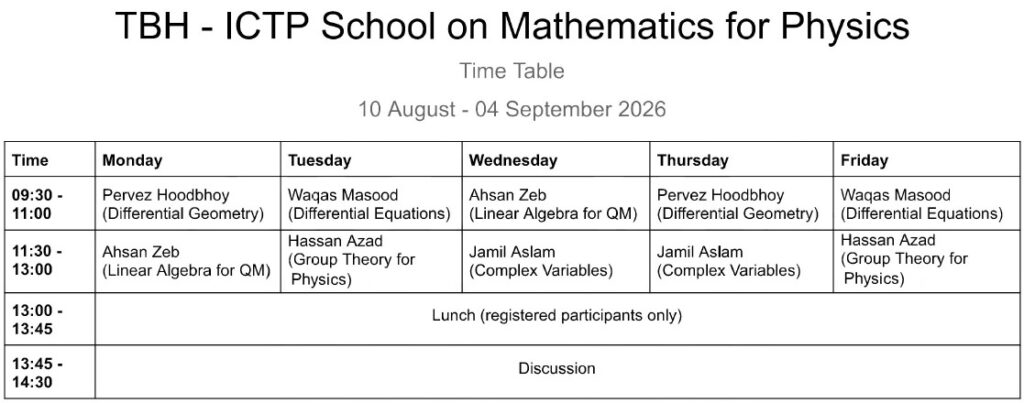
(Click on the time table to enlarge it)
Course Outline:
Introduction to Differential Geometry for Physicists
- Chapter One: Manifolds – The Canvas of Differential Geometry
- Chapter Two: Tangent Spaces, Tensors, and the Metric Tensor
- Chapter Three: Geodesics, Covariant Derivatives, and Curvature
- Chapter Four: Lie Derivatives, Isometries, and Killing Vectors
- Chapter Five: A First Look at Differential Forms and Exterior Derivative
- Chapter Six: Integration of Forms and the Generalized Stokes’ Theorem
- Chapter Seven: Intro to General Relativity and Energy-Momentum Tensor
- Chapter Eight: The Derivation of Einstein’s Field Equations
Recommended Textbooks:
- Differential Forms and the Geometry of General Relativity, by Tevian Dray
- Gravity in a Nutshell, by Anthony Zee
Course Outline:
Group Theory for Physics
- Lecture 1: Vector Spaces, the Fundamental Theorem of Linear Algebra and Dimension
- Lecture 2: Calculus on Subsets of R^N and the Tangent Space
- Lecture 3: Vector Fields, Flows and Invariants
- Lecture 4: Linear Vector Fields, Matrix Groups and the Exponential
- Lecture 5: Curvilinear Coordinates, Canonical Coordinates and Symmetries
- Lecture 6: Applications of Lie Algebras to Solving PDEs
- Lecture 7: Computing Invariant Functions and Operators Using Linear Algebra
- Lecture 8: Using Symmetries to Reduce a PDE to an ODE
Course Outline:
Complex Variables
- Cauchy-Riemann conditions
- Residue Theorem
- Analytic continuation
- Jordan’s Lemma, and Dispersion Relations
- Fourier and Laplace transforms in the complex domain
Course Outline:
Differential Equations
- Introduction to differential equations
- First order linear and nonlinear differential equations
- Second order differential equations
- Green’s function
- Variable coefficient differential equations and power series
- Singular points
- Frobenius series
- Orthogonality of functions
- Sturm Liouville problem
Course Outline:
Operator Methods in Quantum Mechanics
List of Topics:
- Linear Algebra for quantum mechanics
- Quantum Dynamics
- Green functions and effective Hamiltonians
- Composite systems and entanglement
- Open quantum systems
- Coherent states
- Interacting many-particle systems
Outline:
- Linear structure of quantum mechanics: Hilbert spaces, operators, eigenvalues and eigenvectors, spectral theorem.
- Quantum Dynamics: Unitary evolution, pictures, density matrix formalism, qubit dynamics
- Composite systems and entanglement: tensor products; partial trace, pure and mixed states, qubits as examples
- Green functions and effective Hamiltonians: Basic ideas with simple solvable examples (Friedrichs/Fano model), Self-energy; Lamb-like shift and broadening/decay
- Open quantum systems: Kraus operators, completely positive trace preserving maps, decoherence and noise, Markovian dynamics, Lindblad equation, qubit + environment as an example
- Coherent states: Harmonic oscillator, displaced oscillator. coherence functions. Link to macroscopic quantum phenomena
- Many-particle systems: effective interactions: Basic idea of renormalisation and its simpler forms like Schrieffer-Wolf transformations to obtain effective low energy interactions like
Kondo exchange and superexchange, etc.
Recommended Texts:
- R. Shankar, Principles of Quantum Mechanics (Ch. 1)
- Michael A. Nielsen & Isaac L. Chuang, Quantum Computation and Quantum Information (Ch. 2, 8,11)
- Christopher Gerry & Peter Knight, Introductory Quantum Optics (Ch. 3,5,8)
- H.-P. Breuer & F. Petruccione, The Theory of Open Quantum Systems (Ch. 2,3,4)
- Piers Coleman, Introduction to Many-Body Physics (Ch. 16)
For further information:
- sanan@theblackhole.pk